Constitutional Compliance Analytics
Constitutional compliance & jury wheel analytics.
Every jury wheel should be measured, not assumed. EmpanelJMS continuously evaluates source lists, master wheels, and utilization using recognized statistical methods.
A representative jury wheel is fundamental to public confidence in the judicial system. EmpanelJMS gives courts analytical tools that continuously evaluate jury source lists, master wheels, and utilization against recognized statistical methods and established constitutional principles, so a court can document that its selection process is being monitored using objective, repeatable analysis rather than assumption.
Built on Established Legal Standards
Jury administration analysis grounded in decades of jurisprudence.
EmpanelJMS incorporates analytical methodologies drawn from constitutional case law on jury representativeness and selection. Reporting assists courts in evaluating whether source lists and wheels continue to reflect the eligible population throughout the life of the wheel. The analyses provide objective statistical information for court review; they are not intended to replace judicial discretion or legal analysis.
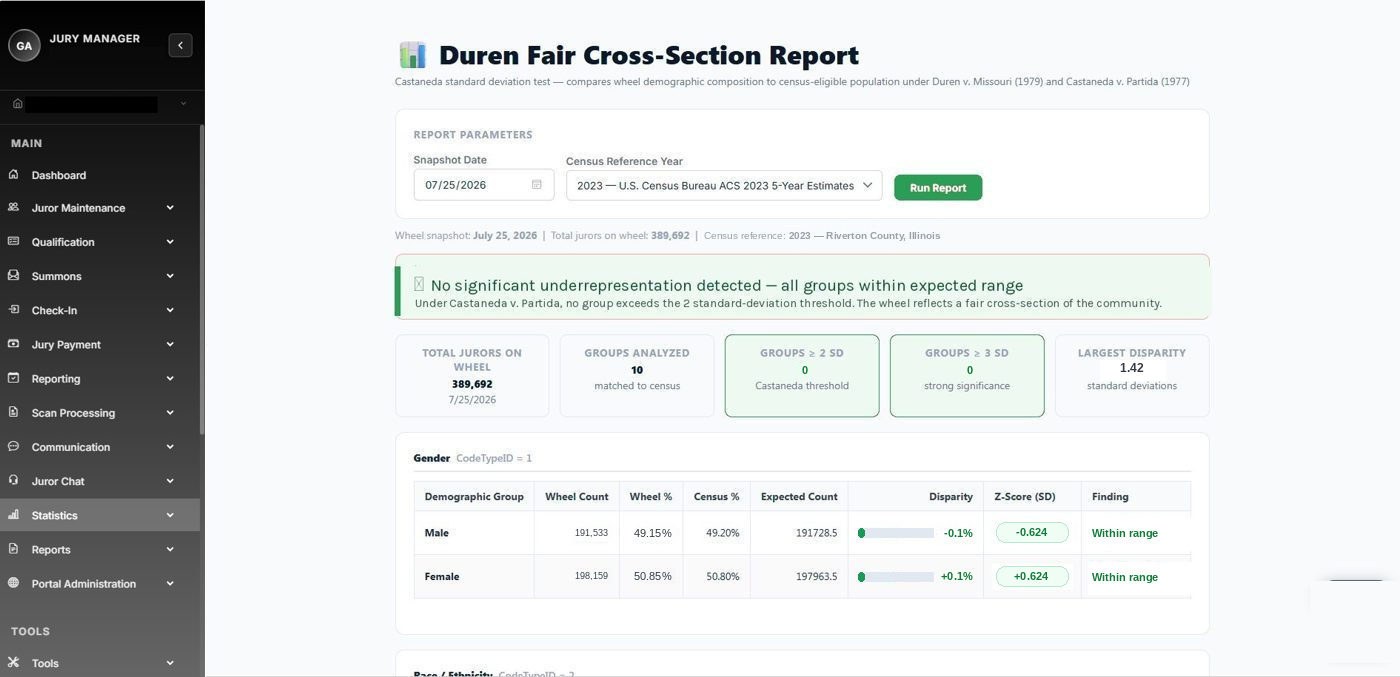
Duren Fair Cross-Section Report
The Sixth Amendment requires jury pools be drawn from a fair cross-section of the community. EmpanelJMS evaluates demographic representation in the wheel against census-based eligible-population estimates, using methodologies commonly associated with Duren v. Missouri (1979) and Taylor v. Louisiana (1975), and identifies potential underrepresentation for the court's review.
Castaneda Standard-Deviation Analysis
Random variation is expected; systematic exclusion is not. EmpanelJMS performs statistical-significance testing using the standard-deviation methodology discussed in Castaneda v. Partida (1977), comparing the wheel's demographic composition with the eligible population and flagging disparities that may warrant additional review.
Batson Challenge Analyzer
Analytical reporting to assist courts in evaluating patterns associated with peremptory challenges, based on methodologies discussed in Batson v. Kentucky (1986), Miller-El v. Dretke (2005), and Foster v. Chatman (2016). Where appropriate, Fisher's Exact Test evaluates whether observed strike patterns differ significantly from chance. Results provide objective statistical information for court review and do not replace judicial discretion.
Disparity Analysis
Both absolute-disparity and comparative-disparity calculations, presented side by side, so courts can evaluate representation using more than one recognized measure rather than relying on a single metric.
Jury Wheel Monitoring
Representation changes over time. So should your visibility into it.
Population shifts. Address quality degrades. Source lists change. Most systems evaluate the wheel only when a challenge is raised. EmpanelJMS is designed to monitor representativeness throughout the life of the wheel, surfacing trends before they become larger issues.
Source list composition
Overlap and coverage across voter registration, driver's license, and state ID lists.
Qualified juror demographics
How the qualified pool compares to the eligible population over time.
Response & excusal patterns
Summons response, excusal, qualification, and failure-to-appear rates by group.
Wheel depletion
How the wheel draws down between rebuilds, and when replenishment is warranted.
Geographic representation
ZIP-code and census-tract representation across the jurisdiction.
Randomization validation
Reporting to demonstrate that selection remains statistically random throughout the process.

Transparent Reporting
Every analysis shows its work.
Methodology, stated plainly
Each report documents the data sources used, the statistical methodology applied, and confidence levels where applicable, so the analysis can be reviewed and understood, not just accepted.
Documentation courts can keep
Graphical summaries, historical comparisons, and exportable reports suitable for review and recordkeeping as part of ongoing jury management.
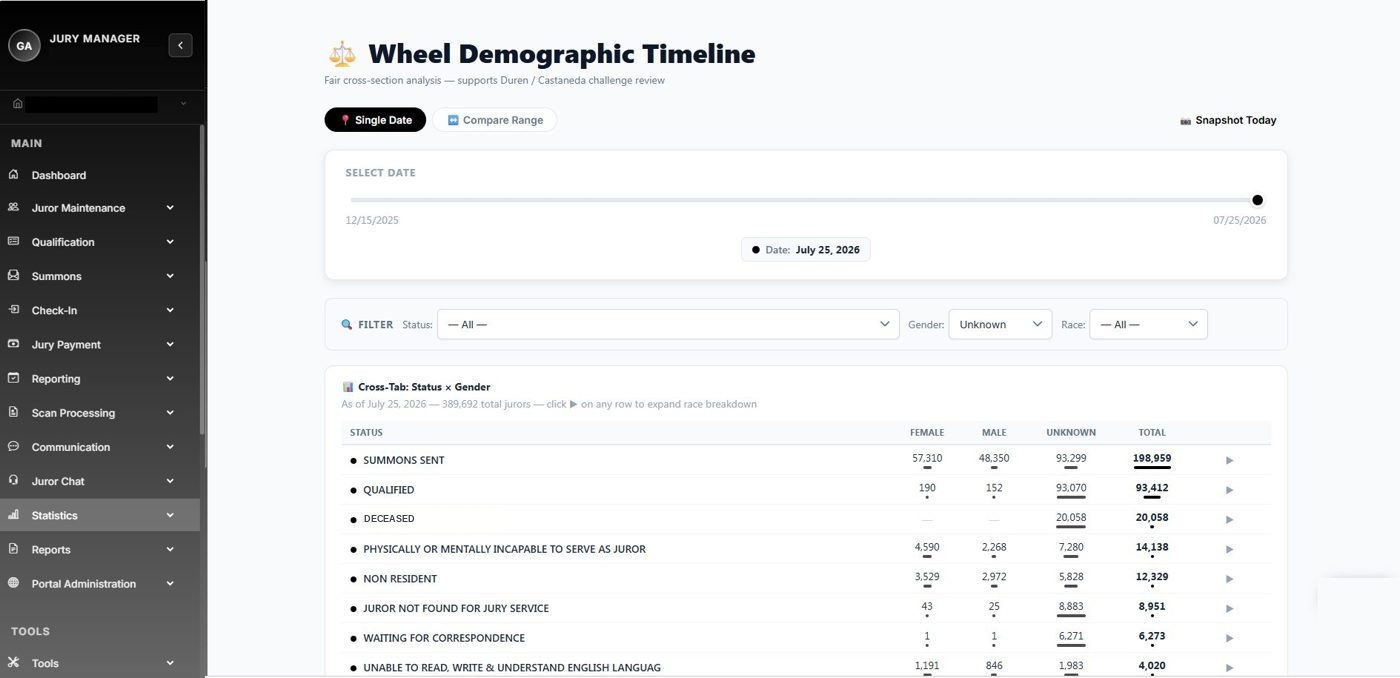
The purpose of these reports is not to replace legal analysis or constitutional review. It is to give court administrators objective, data-driven information that supports informed decision-making, and documents that the jury selection process is being actively monitored using recognized statistical methods.
The analytical reports provided by EmpanelJMS are designed to assist courts by presenting objective statistical information regarding jury wheel composition and representativeness. These reports are intended to support court administration and documentation and should not be construed as legal advice or as a substitute for judicial review, constitutional analysis, or the exercise of judicial discretion.
See jury wheel analytics in your court.
We’ll walk your team through the reports and the methodology behind them.
Request a Demo